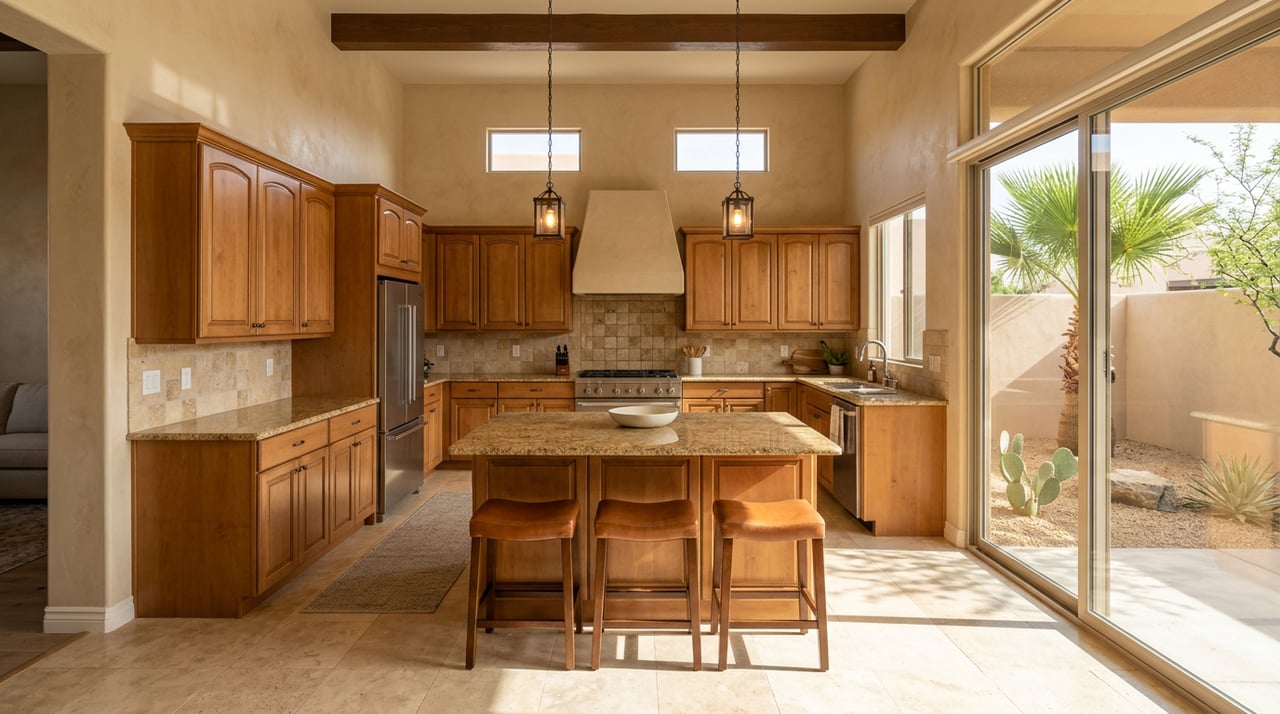
Thinking about gutting your Paradise Valley home or selling it as-is? You are not alone. In an ultra-luxury market where buyers expect standout design and turnkey convenience, deciding where to invest can feel high stakes. In this guide, you’ll get clear ROI benchmarks, a step-by-step comps method to estimate value uplift, and a practical checklist to choose between a light refresh, a full remodel, or listing as-is. Let’s dive in.
Paradise Valley at a glance
Paradise Valley is a small, affluent town with home values that commonly reach well into seven figures, according to U.S. Census data. That combination of small population and high home values shapes how upgrades perform at resale. In this environment, a lower percentage recoup can still mean a significant dollar gain. You can confirm the town’s unique profile through the U.S. Census QuickFacts for Paradise Valley.
The market also sees periodic record-setting luxury transactions that pull averages upward and draw selective, often cash, buyers. Recent reporting highlights that ultra-luxury tail, underscoring how finishes, lot, and views can swing value in large dollar amounts.
A quick note on geography. This guide focuses on the Town of Paradise Valley, ZIP 85253, not Phoenix’s Paradise Valley Village. They are different areas with different price bands and buyer profiles. If you are unsure which applies to your home, see the town’s demographic and boundary resources.
- U.S. Census QuickFacts: Paradise Valley town, Arizona
- Phoenix Business Journal reporting on record sales in Paradise Valley
- Town resource: Paradise Valley Demographics page
Remodel or sell as-is?
In Paradise Valley, smaller cosmetic projects often recoup a higher percentage of cost, while large luxury-level renovations can recoup a lower percentage. That does not mean big projects never pay off. On multimillion-dollar properties, even a modest percentage recoup can translate to a large absolute dollar uplift. The key is to compare your estimated finish premium to real bids and your timeline.
Your decision comes down to three questions:
- What finish level do top nearby comps show, and how far is your home from that standard?
- How much per-square-foot premium do renovated comps achieve over as-is sales near you?
- Do those dollars, minus renovation and carrying costs, beat the net you could achieve selling as-is with strategic staging?
What buyers expect here
High-end Paradise Valley buyers often prioritize contemporary kitchens, spa-like primary baths, seamless indoor-outdoor living, privacy, pools, and finished outdoor kitchens or entertainment zones. When a home lags behind that bar, the buyer pool narrows or offers reflect the work required. Staging and a focused refresh can help reduce the “dated” perception and broaden appeal.
Quality and authenticity matter. Well-maintained architectural details can add character, but builder-grade 2000s finishes or aging tile palettes usually pull offers below renovated comps. Expect longer days on market and stronger negotiation from buyers if finishes trail your neighborhood’s standard.
ROI benchmarks that matter
Remodeling’s Cost vs Value report is a widely used starting point for resale ROI. The 2024 data shows:
- Minor kitchen remodel (midrange): about 96% of cost recouped on average.
- Major kitchen remodel (midrange): about 50% recoup.
- Major kitchen remodel (upscale): about 38% recoup.
- Bath remodel (midrange): about 74% recoup.
- Deck addition (wood): about 83% recoup.
- Entry and garage door replacements: consistently among the highest percentage returns on a small budget.
Use these as baseline guardrails, then adjust for Paradise Valley’s premium labor and finish costs. Local contractors often price above national averages for premium work in Phoenix and Paradise Valley. That means your job cost can be higher than the national line item, even if buyer appeal is strong.
- 2024 Cost vs Value benchmarks
- Phoenix-area remodel cost context for premium baths and kitchens
Light refresh vs full remodel
If you plan to list within 60 to 90 days, lean toward a strategic refresh rather than a full renovation. NAR research indicates staging helps buyers visualize the property and can increase offer prices in many cases. Combine that with paint, hardware swaps, lighting updates, landscaping clean-up, professional photography, and targeted or virtual staging. These smaller moves often land in the few-thousand to low–five-figure range and can shorten time on market.
Consider a larger remodel if:
Your comps show a meaningful per-square-foot premium for renovated homes in your pocket.
You have 6 to 18 months and the budget tolerance for construction risk and carrying costs.
Your home is significantly behind on must-haves for this market, such as a modern kitchen, spa bath, and indoor-outdoor flow.
NAR staging research and guidance
Use comps to price uplift
Here is a simple, repeatable method you can use with your agent:
Define your competitive set. Pull 3 to 5 recent solds within the same micro-area, ideally the same side of the mountain and within about 0.5 to 1 mile. Note sold price, date, condition, finished square footage, lot size, pool or guest house, and whether the listing photos show a recent renovation.
Compute price per finished square foot for each comp. Group them into renovated versus as-is. Use price per square foot as a fast normalization tool. Adjust qualitatively for big differences like views, casitas, or lot size.
Estimate the finish premium. Subtract the average as-is $/sqft from the renovated $/sqft. Multiply that delta by your home’s finished square footage to estimate raw potential uplift. Example formula: Uplift = Subject Sqft × (Renovated $/sqft − As-is $/sqft).
Compare uplift to costs. Get contractor bids for your scope. Subtract renovation cost, permit fees, design and project management, staging, and carrying costs from the uplift. Then factor in transaction costs to estimate net.
Weigh timing and risk. If you need to sell quickly or want to avoid construction risk, selling as-is with smart staging may be better. If net uplift markedly exceeds all-in costs, a remodel can make sense.
Worked example: PV finish premium
The following illustration uses two Paradise Valley sales sourced from MLS aggregators:
- Renovated comp: 6097 N Paradise View Dr sold in Jan 2025 for $3,075,000 at about 4,605 sqft, or roughly $668 per sqft.
- As-is comp: 10006 N 57th St sold in Oct 2024 for $2,175,000 at about 4,922 sqft, or roughly $442 per sqft.
Finish premium estimate: $668 − $442 = $226 per sqft.
If your home is 4,700 sqft, a simple raw uplift estimate is 4,700 × $226 = about $1,062,200. That is the difference between an as-is sale and a renovated sale in this immediate competitive band before subtracting costs. Always adjust for lot size, orientation, mountain views, guest houses, and age. Those factors can narrow or widen the delta.
How costs fit in. In Paradise Valley, a full high-end renovation that includes an upscale kitchen, one or two baths, and premium finishes can reach the mid–six figures to low seven figures. A major upscale kitchen alone can land near the six-figure range in national benchmarks, and local bids often run higher for premium work. If you could complete a targeted scope for $400,000 to $600,000 and hit the renovated comp band, the math could net a meaningful gain. If costs climb toward or above $1 million, the net after commissions and closing costs may be modest or negative.
Decision guide and checklist
Use this quick framework to choose a path:
Timeline
- Listing in less than 3 months. Focus on repairs, paint, lighting, curb appeal, and staging. Avoid opening walls.
- Listing in 6 to 18 months. Pull comps, get contractor bids, and compute finish premium vs all-in costs.
Budget bands
- Under $25k. Light refresh, staging, photography, minor repairs.
- $25k to $150k. Deeper cosmetic updates like a midrange bath, flooring, countertops, and lighting.
- $150k+. Consider a major kitchen or multi-room upgrade if comps support it.
Scope alignment
- Prioritize kitchen, primary bath, flooring, and indoor-outdoor flow over low-impact specialty items.
- Outdoor living sells in PV. Evaluate patio, shade, landscape, and pool presentation.
Cost reality check
- Gather two to three local contractor bids with timeline. Ask about change-order risks.
- Add carrying costs, permits, design, staging, and a contingency.
Market proof
- Use the comps method to estimate finish premium and net uplift after costs.
- Re-run the math if market conditions shift.
Risk tolerance
- If speed and certainty matter most, lean as-is with strong presentation.
- If ROI margin after all costs is clearly positive, consider remodeling.
Common pitfalls to avoid
- Overcapitalizing with taste-specific finishes that limit buyer appeal.
- Ignoring permit needs for structural or systems work, which can delay closing.
- Underestimating timelines and carrying costs during busy contractor seasons.
- Starting multiple projects at once instead of a sequenced plan.
- Skipping a pre-listing inspection on older systems that could trigger renegotiation.
When selling as-is makes sense
If the home has structural or major systems issues like roof, foundation, or mechanicals, retail buyers may hesitate or request large credits. In that case, you can either address critical items before listing or sell as-is and price for the scope a buyer will tackle. If you must move quickly, as-is with strategic staging and excellent marketing can still attract a strong retail buyer pool and avoid a lengthy construction process.
Ready to decide?
You do not need to guess. If you want a clear, design-forward plan to maximize net proceeds, request a pre-listing consult that includes a comps-based uplift estimate, a staging and refresh strategy, and introductions to vetted local contractors for real bids. With bilingual service, design credentials, and hands-on renovation experience, Charlotte Chang can help you model the numbers and present your home at its best.
FAQs
What is the difference between the Town of Paradise Valley and Phoenix’s Paradise Valley Village?
- They are different areas with different price bands and buyer profiles; this guide focuses on the Town of Paradise Valley, ZIP 85253, which you can confirm via the town’s demographics resources.
How much does a minor kitchen refresh typically recoup at resale?
- The 2024 Cost vs Value report shows a minor midrange kitchen remodel recoups about 96 percent on average, though your net depends on local bids and nearby comps.
Do I need to fully remodel before listing in Paradise Valley?
- Not always; if you plan to list in under 90 days, a light refresh plus staging often delivers strong returns and reduces negotiation risk, according to NAR research.
How do I estimate my renovation costs locally in 85253?
- Gather two to three contractor bids for your exact scope and remember Phoenix-area premium work often prices above national averages for upscale finishes.
What features attract luxury buyers in Paradise Valley today?
- High-end kitchens, spa-like primary baths, indoor-outdoor flow, privacy, pools, and outdoor entertainment spaces are common priorities among luxury buyers.